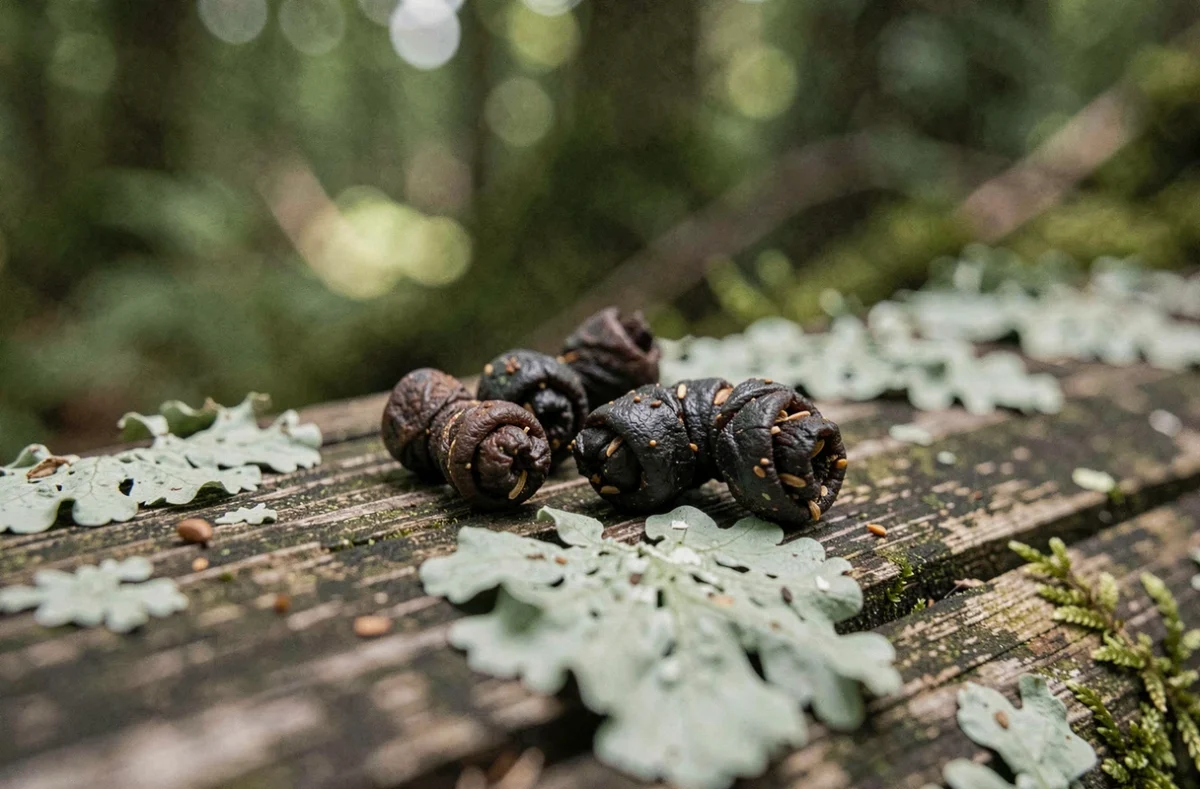
We arrive at a forest trail in the early morning, headlamp still around our neck, and we come across a dark mass prominently placed on a stump. Even before encountering the animal, its droppings tell us about its species, diet, and movement habits. Recognizing the droppings of nocturnal animals in the field requires a simple method: observe the size, shape, visible contents, and especially the location.
Field protocol before touching anything
The first instinct when spotting suspicious droppings is to not move anything. A photo with a scale object (coin, pencil, folding ruler) taken before any handling provides a usable document afterward. Note the location, date, and immediate context (passage between two hedges, base of a wall, latrine on a rock) makes the observation verifiable by a third party or during a later outing.
Wild mammal feces can carry pathogens, especially those from rodents. Therefore, we work with disposable gloves or, if unavailable, we turn a plastic bag inside out over our hand. The smell itself provides a clue, but we capture it by gently wafting above the sample, without bringing our nose closer than about twenty centimeters.
When we want to explore Planète Animaux in detail, we find that photographic comparison remains one of the most reliable means to confirm a hesitant identification.
Nocturnal rodent droppings: rat, mouse, and dormouse in the garden
Rodents represent the majority of clues found around homes. Their small size complicates distinction, but a few criteria quickly clarify.

- The mouse leaves droppings comparable to a grain of rice, thin and pointed at both ends, deposited in numbers along its usual routes (baseboards, behind furniture, under the sink).
- The rat (brown rat or black rat) produces thicker droppings, spindle-shaped, often grouped in small piles. Those of the black rat are slightly curved, while those of the brown rat remain straight.
- The dormouse and the hazel dormouse leave droppings of intermediate size, often in attics or nesting boxes. They can be distinguished from rat droppings by their smoother surface and their location at height.
A complementary clue: rodents almost always leave gnawing marks nearby (cables, cardboard, nut shells). If we find droppings without any visible damage, we can already rule out the rat.
Droppings of hedgehog, marten, and fox: three very different profiles
Moving away from the realm of rodents, confusions mainly occur between marten and pine marten, or between fox and dog. Again, the context of observation helps as much as the morphology of the droppings.
Hedgehog: an easy clue to confirm
The droppings of the hedgehog are cylindrical, black, and shiny, often deposited in the middle of a lawn or path. Fragments of insect elytra (beetles, carabids) are frequently spotted, reflecting its insectivorous diet. The diameter remains modest, and the droppings do not show any twisting.
Marten and pine marten: location makes the difference
Both species produce twisted droppings, often tapered at one end, with visible remnants of fruits, hair, or feathers to the naked eye. The distinction relies less on the droppings themselves than on where they are found. The marten deposits its feces in buildings (attics, garages, car hoods), while the pine marten uses latrines in the forest, on stumps, or overhanging rocks.
The smell of marten droppings is particularly pungent, and accumulation in a fixed point (latrine) confirms the animal’s long-term presence in the structure.

Fox: twisting and territorial marking
The fox’s droppings are longer and thicker than those of the marten, also twisted, often deposited prominently on a mound of earth, a flat stone, or at the intersection of two paths. This positioning serves a territorial marking function. We observe hair, fragments of bone, seeds, or remains of berries depending on the season. The characteristic musky odor of the fox lingers for several days at the deposit site.
When identification remains uncertain: cross-referencing clues
Shape alone is not always sufficient. Seasonal diet alters the color and consistency of the droppings: a fox feeding on blackberries in August produces purple droppings, very different from its grayish winter droppings filled with hair. Similarly, the droppings of a hedgehog that has consumed slugs will be softer and less structured than those of an individual with a diet rich in beetles.
We gain reliability by combining several clues at the same site:
- Ground footprints, even partial, help confirm or refute the suspected species (number of toes, presence or absence of claws).
- Repeated passage traces (flattened grass, hole under a fence, trail in vegetation) indicate a regular route.
- Associated damage guides the diagnosis: torn insulation for the marten, lawn turned into small cones for the badger, broken snail shells for the thrush (not to be confused with a mammal).
The key to mammal droppings published by FNE Auvergne-Rhône-Alpes provides a simplified identification tree, useful to take into the field in printed form.
A regular field notebook, even a brief one, allows for tracking seasonal variations and distinguishing a unique passage from a long-term establishment. When documenting a site over several weeks, the nature of the droppings almost always resolves any doubt.