
A player ranked in the top 50 in the world does not pay an entry fee to access the main draw of Roland-Garros. Their ATP or WTA ranking opens the door directly. However, participating in this Grand Slam tournament incurs real costs, often unknown to the general public, which weigh differently depending on the player’s level and journey.
There is often confusion between the entry fee for the Roland Garros tournament and spectator tickets or the federal license. These three items have nothing to do with each other, and conflating them completely distorts the understanding of the actual cost for a competitor.
FFT License and Tournament Entry: Two Distinct Budget Lines
The French Tennis Federation offers a club license priced at 33 euros for adults, 23 euros for those aged 7-18, and 13 euros for those aged 6 and under. This license allows for competitive tennis practice in France, obtaining an official ranking, and benefiting from advantages on Roland-Garros tickets.
This license is not a ticket to enter the Roland-Garros draw. The FFT license and tournament registration are two separate systems. A French player must hold their license to compete in the federal system, but this is just one administrative condition among others. Access to the Paris Grand Slam depends on world ranking, qualifications, or an invitation (wild card).
This confusion is regularly observed in online articles: the license fee is presented as the “registration cost” for the tournament. In reality, no official public registration fee for players in the main draw of Roland-Garros is published by the FFT or the tournament itself.
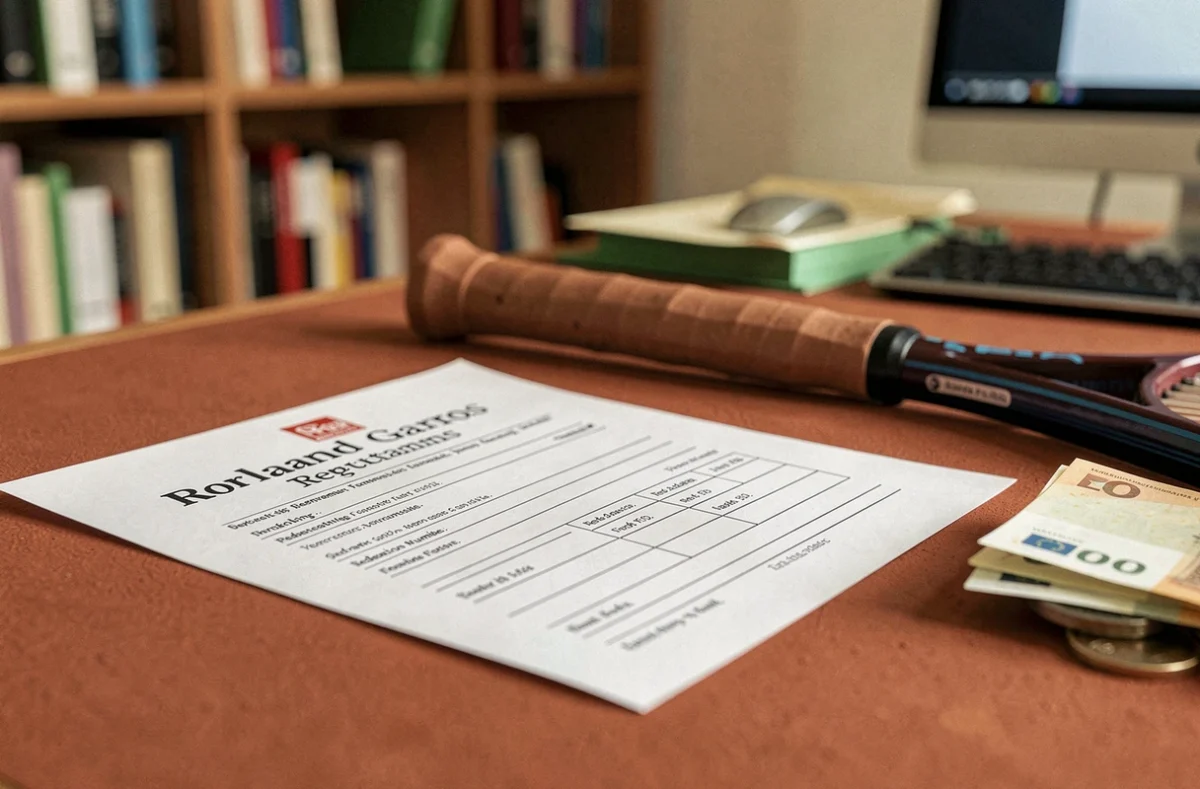
Roland-Garros Qualifications: The Costly Path That Isn’t Charged
Players who are not directly admitted to the main draw go through the qualifications. These preliminary rounds take place a few days before the official start of the tournament, on the courts of the Roland-Garros stadium.
No specific entry fee for the qualifications is made public. Players gain access based on their ATP or WTA ranking, according to a threshold that varies each year depending on the number of entries. The tournament does not charge participation fees to those who qualify.
The real costs lie elsewhere. A player arriving in Paris for the qualifications personally finances (or through their team) several concrete items:
- Accommodation in Paris for one to two weeks, in a city where hotel rates rise sharply during the Roland-Garros fortnight
- International transport for foreign players, sometimes from another continent, with bulky equipment
- Payment for the coach, physical trainer, or physiotherapist accompanying the player on-site
- Daily food and logistics expenses over a period that can extend if the player progresses through the rounds
For a player eliminated in the first round of qualifications, the incurred expenses can far exceed the earnings received. The prize money awarded to players eliminated early in the draw remains modest compared to the overall cost of a trip to Paris.
Prize Money and Profitability: The Calculation Players Make Before Registering
There is often talk of the total prize money of Roland-Garros, which is among the highest on the circuit. The names of Rafael Nadal or Novak Djokovic are associated with substantial earnings on the Parisian clay. For these champions, the question of participation costs does not arise: their sponsorship contracts and earnings more than cover their expenses.
The situation is radically different for a player ranked beyond the hundredth place in the world. The profitability of a trip to Roland-Garros depends on the number of rounds progressed. A player defeated in the first round of the main draw receives a bonus, but this must cover all incurred expenses, sometimes over several weeks of preparation.
The Case of Amateur and Semi-Professional Players
Amateur players do not gain direct access to the Roland-Garros stadium. Their journey goes through regional tournaments, then national ones, organized under the aegis of the FFT. At each stage, specific registration fees apply for local tournaments, but these fall under the French federal circuit, not the Grand Slam.
For an amateur dreaming of stepping onto the Parisian clay, the financial path begins well before Paris. Club membership fees, FFT license, travel to tournaments on the French calendar: the annual budget of an amateur player engaged in competition represents a significant investment, even without ever reaching Roland-Garros.

Why No Official Player Registration Amount Is Published
The four Grand Slam tournaments (Roland-Garros, Australian Open, Wimbledon, US Open) operate on a ranking-based admission model, not on an open paid registration model. This is a fundamental difference from amateur tournaments or local competitions where each participant pays an entry fee.
The FFT and the Roland-Garros tournament do not publish a registration fee schedule for professional players. The information available online pertains either to the federal license, spectator tickets, or the financial prizes awarded to participants. None of these three categories corresponds to the “registration fee” as understood for a traditional tournament.
Feedback varies on this point depending on the sources consulted, and it is likely that administrative fees exist in the registration process. However, their exact amount remains absent from the official communications of both the tournament and the federation.
What the FFT Actually Finances with Ticket Sales
The spectator ticket sales, for which the prices for qualifications and the main draw are published each year on the official website, constitute one of the major sources of revenue for the tournament. These proceeds finance the organization, the stadium’s infrastructure, and the prize money distributed to players.
Players do not pay to play, but the public pays to watch them play. This economic model, common to Grand Slams, explains why the question of the “registration fee” for a player does not have a simple answer: the direct cost is zero or marginal, but the indirect cost of participation remains high for players outside the world top.
The Roland-Garros system relies on a balance where selection is based on sporting merit and not on financial capacity to register. The actual expenses of a player are measured in plane tickets, hotel nights, and training hours accumulated long before the first ball is struck at Porte d’Auteuil.