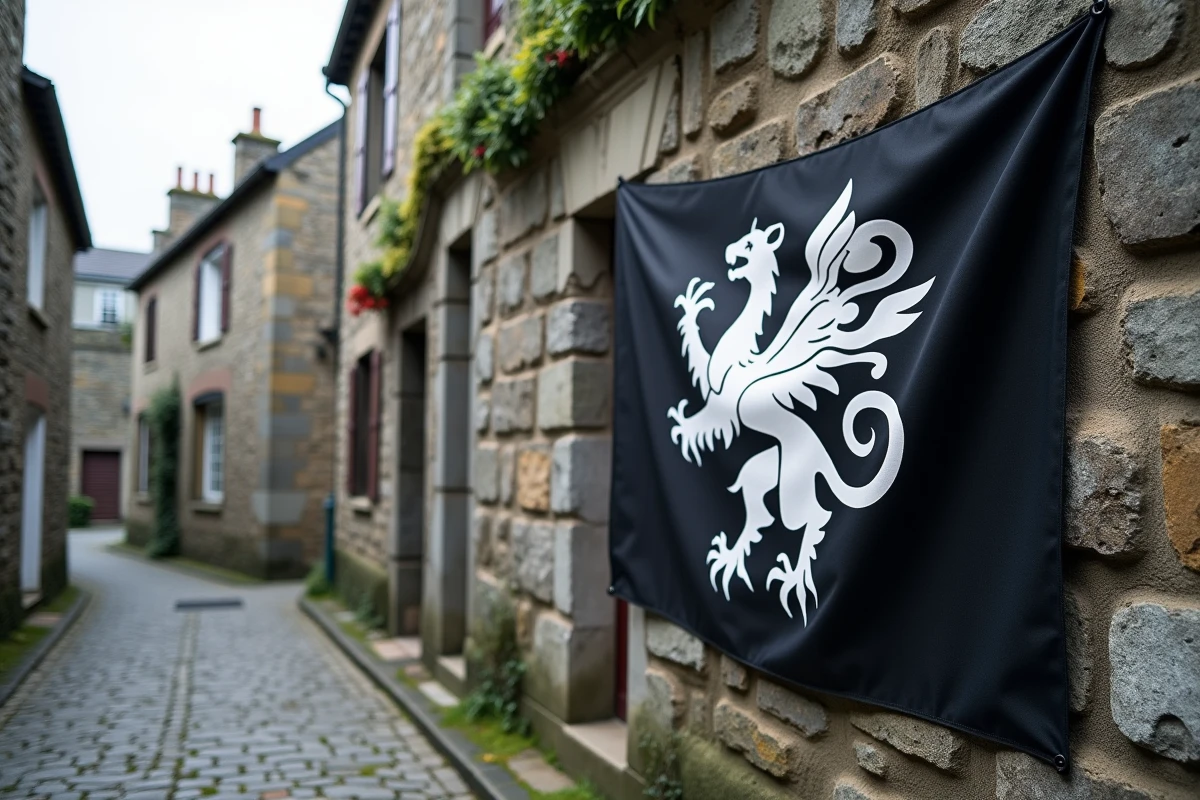
The Gwenn ha Du, the black and white flag of Brittany, flies on facades, at festivals, and at events well beyond the five historical departments. Its design, at the intersection of medieval heraldry and early 20th-century nationalist design, embodies formal choices that deserve to be read with precision.
Gwenn ha Du and legal framework: a regional flag under legal tension
Most online content claims that no law prohibits the use of the Breton flag. The legal reality is more nuanced. French legislation reserves the official masts of public buildings for the national, European, and, where applicable, municipal flags.
Since the end of the 2010s, several local authorities have more strictly regulated the display of regional flags on public buildings, following reminders from the Ministry of the Interior and local jurisprudence. These decisions have sparked recurring debates in Brittany, where the Gwenn ha Du is seen as a natural extension of local identity.
Better understanding the history and meaning of the Breton flag helps explain why this piece of fabric crystallizes so much passion, including in the legal arena. In contrast, in private and associative spaces, no restrictions apply: flag display remains free.
Nine stripes of the Breton flag: coded geography of the bishoprics
The Gwenn ha Du consists of nine horizontal stripes alternating black and white. This is not an arbitrary aesthetic choice. Each stripe represents one of the nine historical bishoprics of Brittany, divided into two linguistic groups.

- The four white stripes correspond to the Breton-speaking bishoprics (Lower Brittany): Léon, Trégor, Cornouaille, and Vannetais.
- The five black stripes correspond to the Gallo-speaking bishoprics (Upper Brittany): Rennes, Nantes, Dol, Saint-Malo, and Saint-Brieuc.
- The black-and-white alternation visually represents the coexistence of these two cultural and linguistic areas within the same territory.
This textile mapping raises a rarely asked question: the flag includes Nantes among the Breton bishoprics, even though Loire-Atlantique has been administratively attached to Pays de la Loire since the 1940s. The Gwenn ha Du thus carries a territorial division predating that of the Republic, fueling the debate on administrative reunification.
Ermine spots: medieval origin and variations of the Breton symbol
The upper left canton of the flag displays black ermine spots on a white background. The ermine is the oldest heraldic symbol of Brittany, present on ducal coats of arms since the Middle Ages.
The number of spots has varied according to versions. The most common version has eleven, but this number is not fixed by any official text. Earlier versions displayed a different number, and some contemporary representations take liberties with the arrangement.
Legend of the ermine and heraldic reality
Popular tradition associates the ermine with the motto “Rather death than stain,” attributed to the Dukes of Brittany. The animal, whose white winter fur was prized by European nobility, was said to prefer death over crossing a puddle of mud and soiling its fur. This legend underpins the association between purity and Breton identity in the collective imagination.
In heraldic terms, the ermine spot is a codified figure: three points topped with a small cross. It does not represent the animal itself, but a stylization of the black tail of the ermine fixed on royal and ducal mantles. The confusion between the motif and the animal persists in many public presentations.

From activism to pop culture: how the Gwenn ha Du has changed its register
The Breton flag was designed in the 1920s, in a context of regionalist claims. Its creator, Morvan Marchal, an architect and activist, was inspired by the striped flags of other European nations. Originally, the Gwenn ha Du carried an explicit political charge linked to Breton autonomist movements.
Since the 2010s, the flag has increasingly been waved in non-nationalist contexts: concerts, sporting events, culinary festivals, local ecological struggles. Research in sociology and anthropology notes a shift in usage: younger generations perceive the Gwenn ha Du as a festive and cultural marker, rather than a political banner.
This shift is also reflected in the connection between the flag and language. The Gwenn ha Du now accompanies bilingual policies, French-Breton signage, and communication campaigns on learning Breton. New speakers cite it as a visible identity marker in urban spaces and on social networks, indicating that the symbol has migrated from the activist field to the everyday sphere.
A regional flag with international reach
The Gwenn ha Du travels far beyond the Armorican peninsula. It can be found in Breton communities established in North America, Australia, and several European countries. International Celtic festivals include it alongside Irish, Scottish, and Welsh flags, reinforcing its positioning within the family of contemporary Celtic symbols.
Unlike other French regional flags, the Gwenn ha Du enjoys strong visual recognition even outside France. This notoriety is due as much to the Breton diaspora as to the graphic effectiveness of black and white, immediately identifiable in a sea of colorful flags.
The Breton flag remains a living object, whose meaning is recomposed with each generation. Its interpretation oscillates between ducal memory, linguistic claims, and relaxed regional pride, without any of these layers erasing the previous ones.