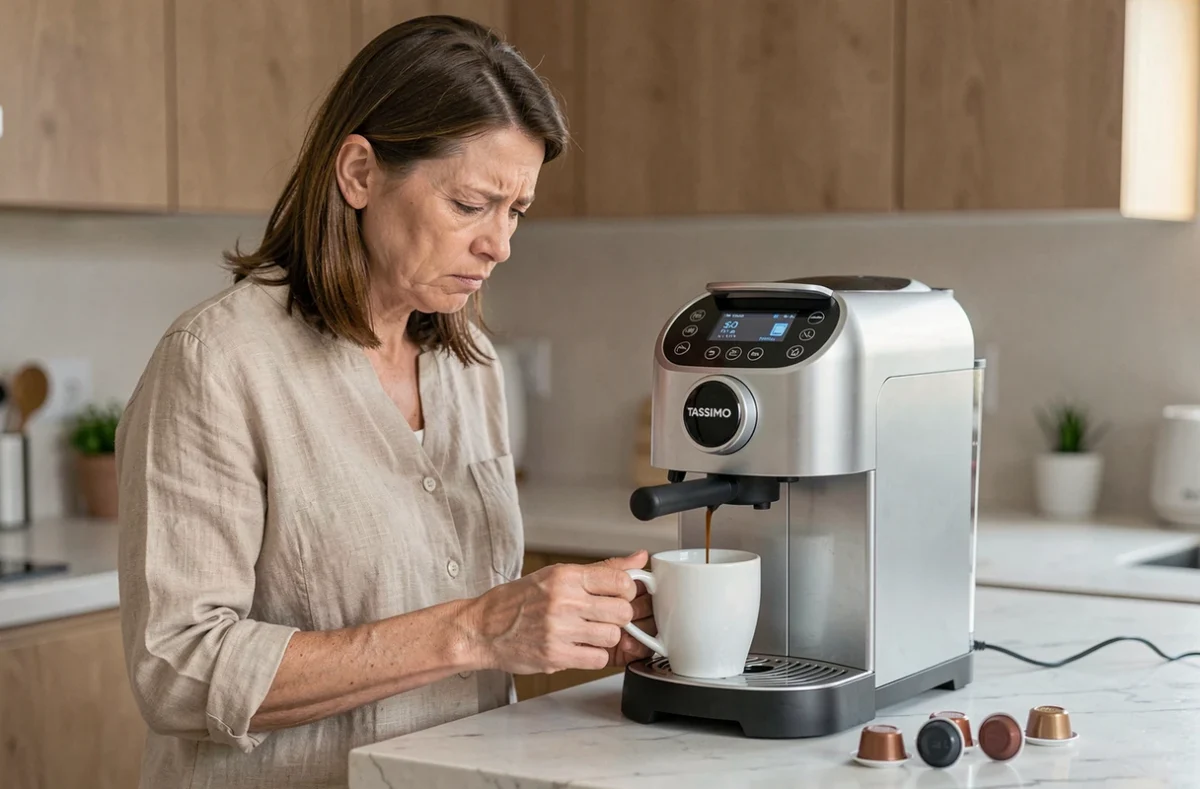
Your Tassimo barely fills half the cup while it was producing a long coffee without issue a few weeks ago. The instinct would be to suspect a malfunction, but the cause is often simpler (and more insidious) than a faulty component.
The T DISC barcode programs the volume, not your machine
Each Tassimo capsule carries a barcode that the machine reads before starting the extraction. This code dictates three parameters: the water volume, the temperature, and the brewing time. In other words, it’s the capsule that decides the size of your coffee, not the machine.
You may have changed the T DISC reference without noticing. An espresso and a long coffee do not carry the same barcode. The volume obtained in the cup can vary significantly from one capsule to another, without any malfunction being involved.
Before disassembling anything, check the packaging of your capsules. If you want a generous volume, opt for the T DISC labeled “XL”. Their barcode commands a higher water volume and they work in all compatible Tassimo machines, without any additional accessories. This is the first avenue to explore for solving a Tassimo coffee machine issue that seems to no longer fill the cup.
Limescale and water circuit: when the machine throttles the flow
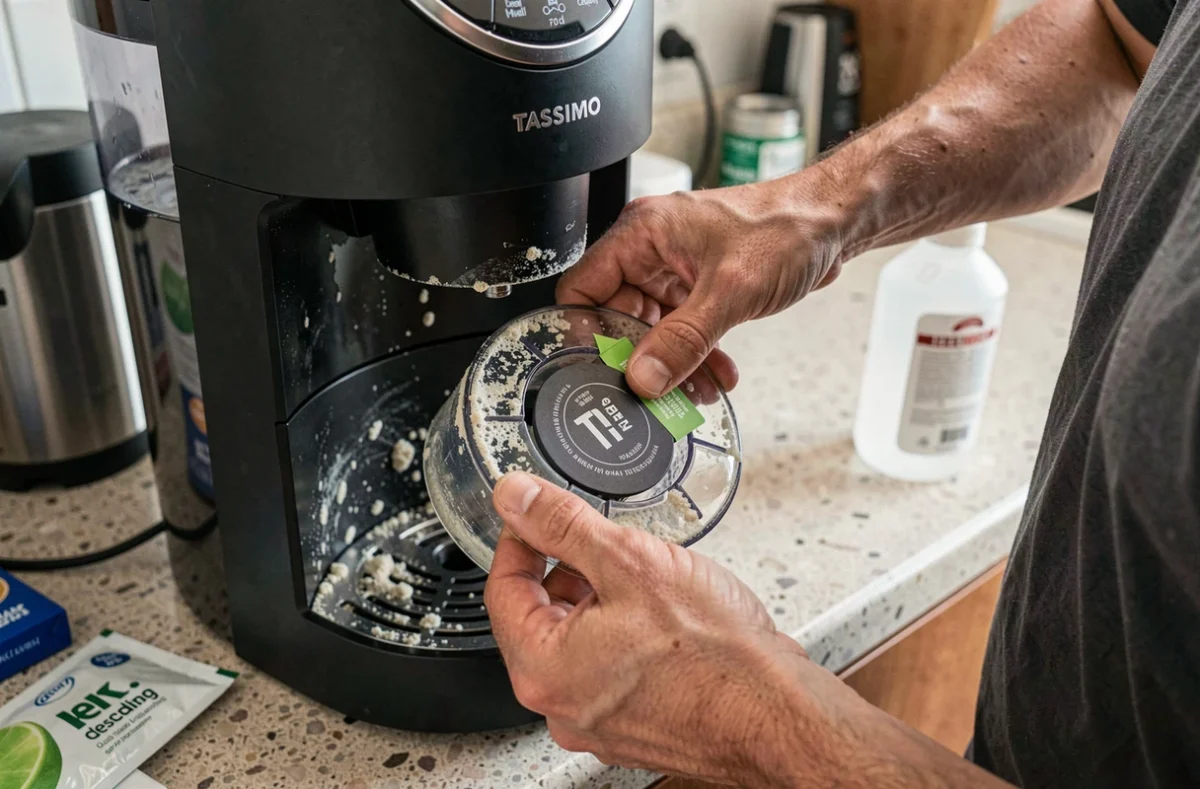
If the type of capsule is not the issue, limescale probably is. Limescale gradually deposits in the internal circuit, reducing the diameter of the conduits and slowing down the pump. The result: the machine sends less water than the barcode requests.
Identifying the need for descaling
Most Bosch Tassimo models display a red “calc” light when descaling becomes necessary. Ignoring this signal does not cause an immediate malfunction, but the coffee volume gradually decreases until it becomes frankly insufficient.
The descaling process uses two specific tablets dissolved in the reservoir filled to the “calc” mark. The cycle starts by inserting the maintenance T DISC provided with the machine. Allow about twenty minutes for the entire process, including rinsing.
The water reservoir, a false friend
A poorly seated reservoir or a stuck float can mislead the machine about the available water level. Remove the reservoir, clean it with clear water, check that the float moves freely, and then reposition it until it clicks. This action takes thirty seconds and can sometimes restore normal flow.
- Float stuck by limescale: the machine thinks the reservoir is empty and stops the cycle prematurely.
- Dirty reservoir seal: a poor seal causes air intake that disrupts the pump’s suction.
- Water level too low: insufficient filling mechanically limits the volume available for extraction.
Tassimo machine model and volume adjustment
You have descaled, checked the reservoir, and chosen XL capsules, but the coffee remains too short. The problem may come from the model itself. Not all Tassimo machines allow for manual volume adjustment.
Entry-level models (Suny, Happy, Finesse) rely exclusively on the T DISC barcode. The Finesse and Harmony Plus add an intensity setting, but no direct control over the amount of water dispensed. Only the My Way 2 model offers the ability to adjust and memorize the volume, intensity, and temperature for each drink.
In practical terms, if you own a Suny and the XL capsules do not give you the desired volume, you have no software lever. The only option would be to change to a machine with advanced settings.
Cleaning the reading head and Tassimo capsule holder
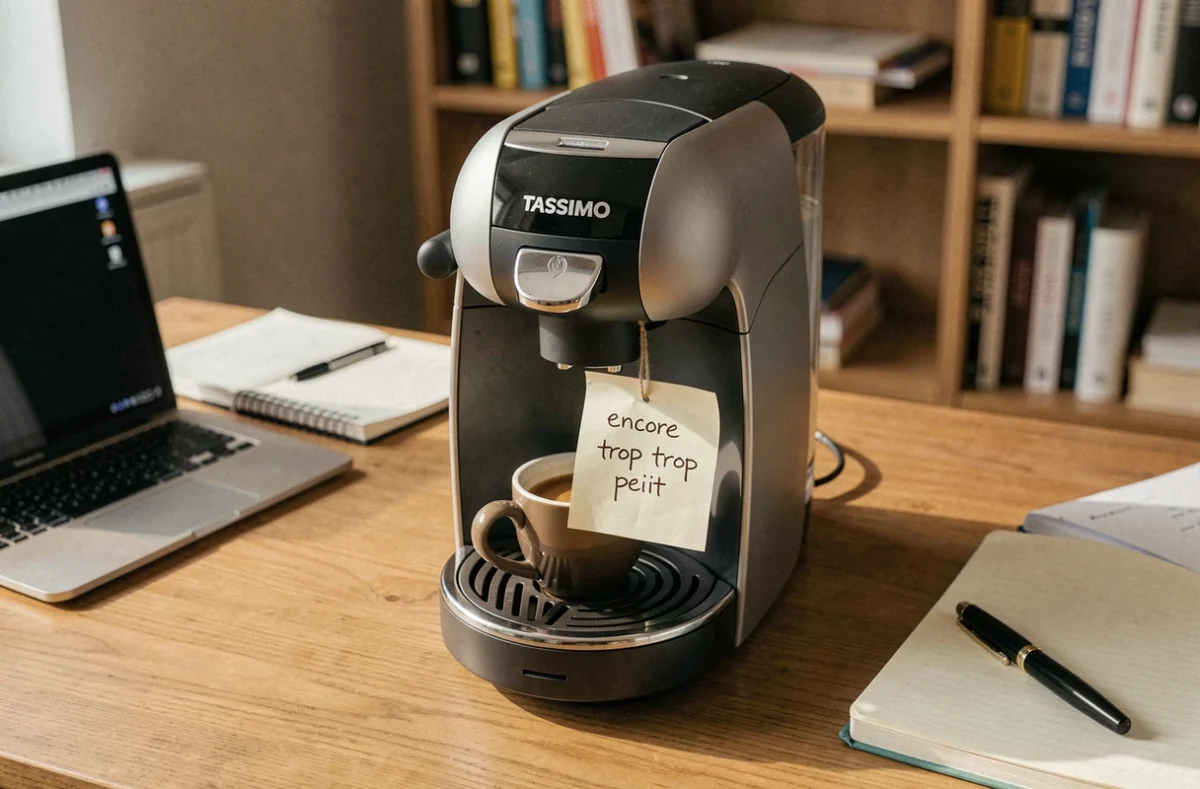
The barcode is useless if the machine cannot read it correctly. Dried coffee or milk residues on the optical reading head can distort the program’s interpretation.
Open the capsule holder, remove the T DISC, and inspect the reading area (the upper part that comes into contact with the capsule). A damp cloth is enough to remove the deposits. Take the opportunity to clean the punch located opposite: a partially obstructed punch reduces the water flow through the capsule.
This quick cleaning should be done weekly if you use hot chocolate or milk capsules, which leave stickier residues than those from black coffee.
Rechargeable capsules: a false good idea for volume
Some users try to circumvent the problem by purchasing rechargeable capsules. The reasoning seems logical: fill the capsule yourself to control the dose. In practice, the Tassimo system relies entirely on the optical reading of the barcode to set the cycle.
A rechargeable capsule without a recognized barcode can prevent the cycle from starting or produce an unpredictable result. The Tassimo system is not designed to operate without a readable barcode. If a large coffee remains your priority, the official T DISC XL remain the most reliable option.
- Capsule without a barcode: cycle not started or interrupted by the machine.
- Capsule with a generic barcode: random volume and temperature, extraction often too short.
- Official XL capsule: adapted program, calibrated volume, reproducible result with each cup.
Short coffee on a Tassimo rarely stems from a single cause. An unnoticed capsule change, a delayed descaling by a few weeks, and a poorly clipped reservoir can combine to halve the volume. Checking these three points in order takes less than five minutes and resolves the majority of cases without technical intervention.