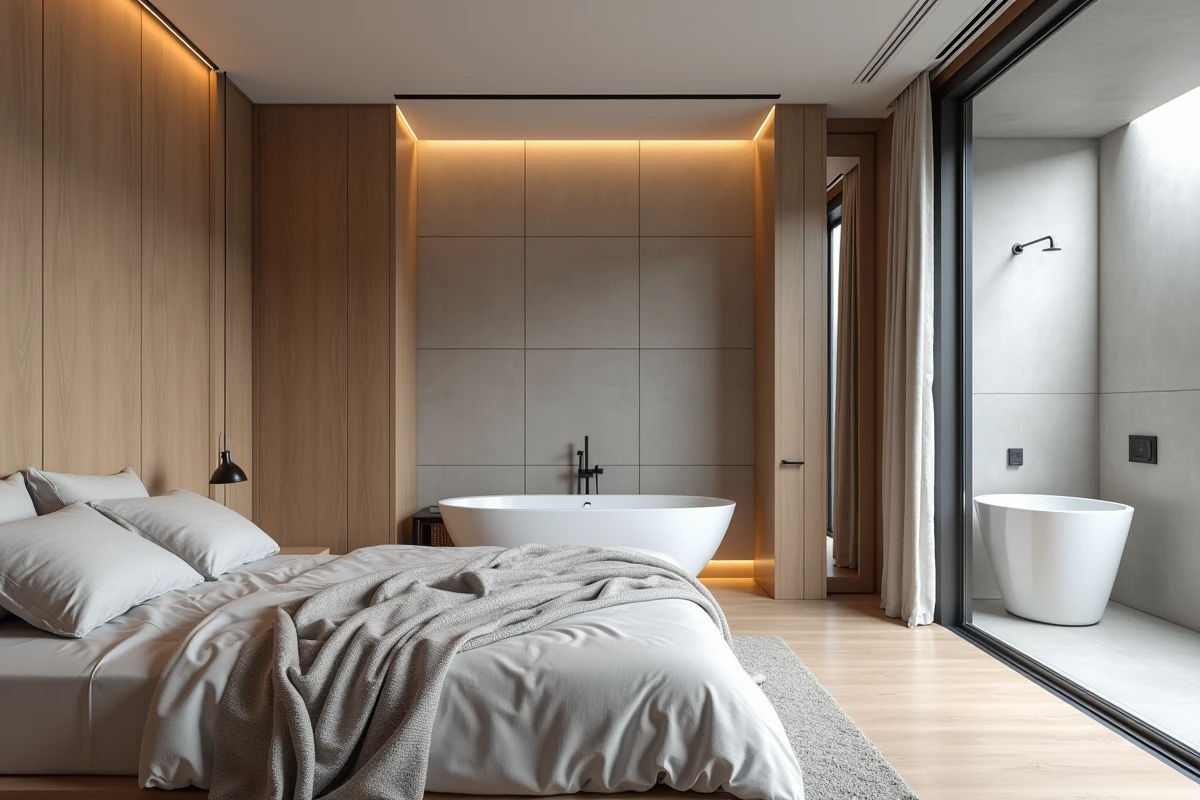
Designing a master suite in a room of fifteen square meters requires balancing comfort, functionality, and technical feasibility. Most online guides focus on bed placement and the choice of vanity unit. However, the constraints that determine the project’s success on a daily basis are often absent from the plans: noise from ventilation, humidity management, access to plumbing for maintenance.
Noise and ventilation in a master suite with an open bathroom
Incorporating a shower or a water point in the bedroom creates an acoustic problem that 3D visuals do not show. The hum of a mechanical ventilation system, the clatter of a mixer tap, the flow in a drain: these sounds disrupt sleep when the bathroom is separated only by a half-partition or a glass wall.
Controlled mechanical ventilation remains the most reliable way to expel humidity produced by daily showers. However, a mechanical ventilation system is not always integrable due to a lack of technical evacuation duct. In older buildings, the technical column may be several meters away from the planned location for the bathroom, complicating the passage of ducts and increasing noise levels.
When developing a 15m2 parental bedroom plan with a bathroom, the layout of the ventilation duct should be included in the plan even before choosing the shower tray. Placing the extraction vent as close as possible to the technical column reduces duct length, thus minimizing noise and pressure losses.

Humidity and waterproofing: what the plan doesn’t say about the 15m2 parental bedroom
An open bathroom in the sleeping area, even partially, releases steam into a closed volume. Without appropriate treatment, the first signs appear within a few months: peeling paint at the head of the bed, mold at the baseboards, persistent musty odors.
Waterproofing under tiles (SPEC) is the first line of defense. It is applied to the walls of the shower area and on the floor up to the limit of the wet area. This flexible membrane prevents water from migrating to the structure, but it requires meticulous installation at the joints and pipe penetrations.
The choice of wall covering on the bedroom side also matters. A lime plaster or microporous paint allows the wall to breathe while limiting condensation. Vinyl wallpapers, often recommended for their decorative appearance, trap moisture between the wall and the covering, accelerating degradation.
Light separation and shower deflector
The trend in small master suites leans towards modular separations rather than total closure. A compact shower wall with a deflector limits splashes without enclosing the wet area. This type of configuration works as long as ventilation is adequate: without effective extraction, steam migrates towards the bed and textiles.
A half-brick partition (about ten centimeters thick) offers an interesting compromise: it blocks direct splashes, creates a support for a wall-mounted vanity unit, and allows for hiding water connections on the non-visible side.
Technical access and plumbing maintenance in a master suite plan
A 15m2 parental bedroom plan with an integrated bathroom often places plumbing against a load-bearing wall or along a partition. If these pipes are sealed without an access hatch, even the smallest leak requires breaking the tiles or cladding to intervene.
- Provide an access hatch of at least forty centimeters on each side at the height of the connections for the shower and sink, especially if the siphons are recessed.
- Group the water inlets and outlets on a single wall (technical wall) to limit pipe lengths and facilitate future access.
- Position the water heater or tank (when it is in the room) in an accessible area without moving fixed furniture.
A single technical wall simplifies maintenance and reduces intervention costs. This principle also applies to resale: a savvy buyer quickly notices an installation where nothing is accessible.
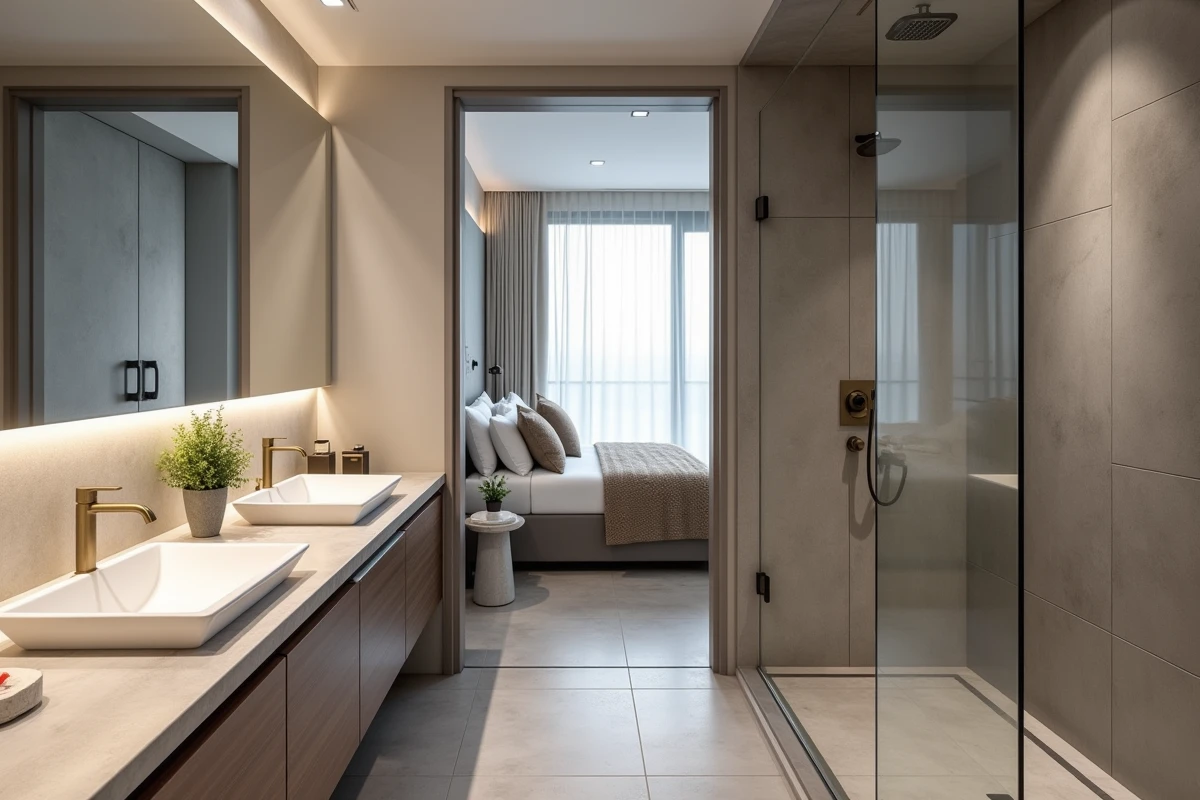
Bed arrangement and circulation in a 15m2 sleeping area
After addressing the technical constraints (ventilation, waterproofing, access), the placement of furniture becomes clearer. The bed remains the dominant element: a 160-centimeter wide bed with a headboard already occupies a significant area.
The circulation axis between the bed and the side walls should not drop below fifty to sixty centimeters on each side. Below this, making the bed or placing a glass of water on a nightstand becomes acrobatic.
Dressing room or bathroom, rarely both
In a parental bedroom plan of this size, integrating a full dressing room and a bathroom remains very difficult without sacrificing circulation. A linear dressing room (sixty centimeters deep, two meters fifty wide) consumes more than one meter fifty of usable depth with the necessary clearance to open the doors.
- If the room is five meters long or more, a linear arrangement (bed, then low partition, then shower corner at the back) remains the most functional configuration.
- If the width exceeds three meters, the bathroom corner can be placed laterally, freeing up the back of the room for storage.
- For square rooms (around 3.80 m on each side), a corner bathroom with diagonal access offers a good compromise between privacy and flow.
The shape of the room dictates the layout as much as the area. Two fifteen-square-meter rooms with different proportions do not accommodate the same plan.
Before choosing a covering or fittings, the plan must answer three concrete questions: where does the ventilation duct run, where are the access hatches, and which wall carries the plumbing. Making these decisions in advance avoids costly revisions and ensures a sleeping area that remains pleasant after several years of daily use.