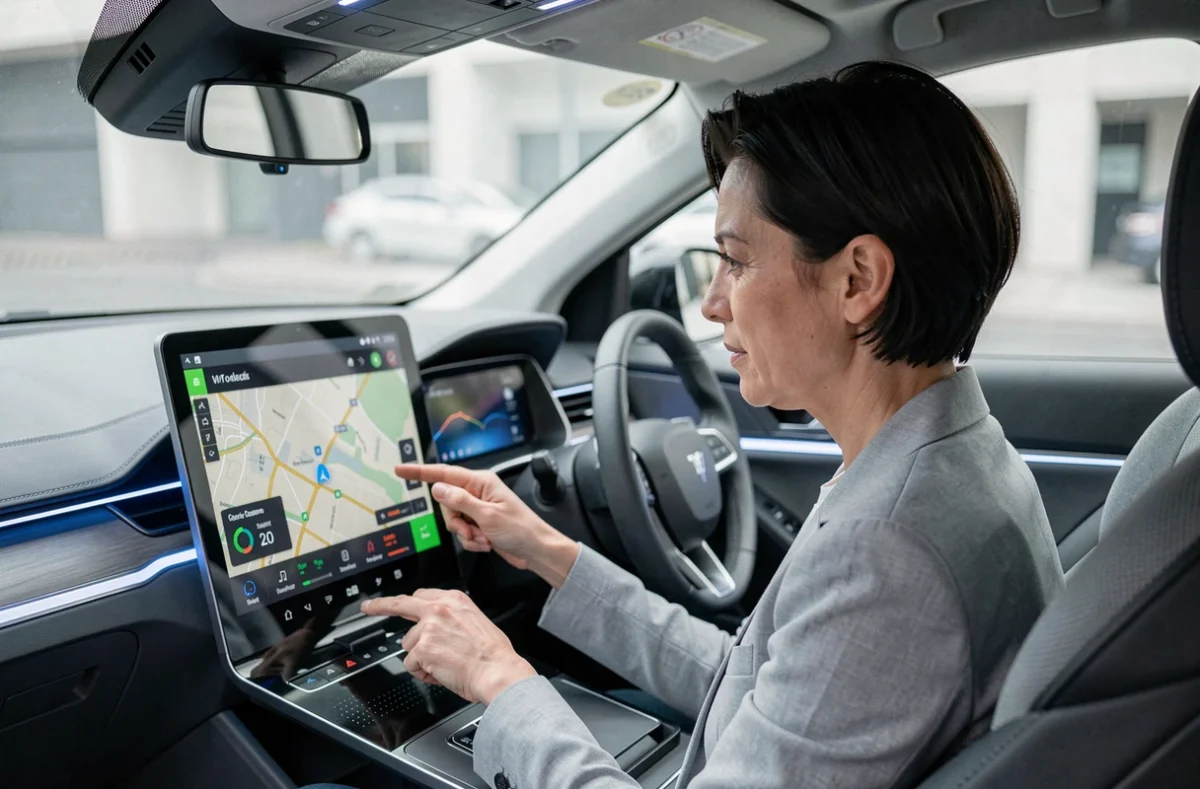
Since 7 July 2024, every new vehicle registered in the European Union has been required to include an Intelligent Speed Assistance (ISA) system. This digital device alerts the driver when they exceed the speed limit, without preventing them from pressing the accelerator. It can be switched off manually and is reactivated when the vehicle restarts.
This requirement, introduced by Regulation (EU) 2019/2144, illustrates how digital innovations are transforming the automotive sector: not by imposing automation, but by introducing software layers that gradually change the relationship between drivers and their vehicles.
Driving data: who decides how it is used in a connected vehicle
A modern connected vehicle continuously generates data on speed, braking, geolocation, fuel consumption and even tyre condition. The key question is not technical but legal: who can access this data, and under what conditions?
The European Data Act (Regulation (EU) 2023/2854) provides a clear framework. Since 12 September 2025, users of connected vehicles have been able to request access to the readily available data generated by their vehicles. They can also authorise its sharing with a third-party provider of their choice, such as an independent garage, fleet manager or insurer.
For products placed on the market after 12 September 2026, a separate design requirement will apply: data must be accessible by default. This phased timeline is changing the balance between car manufacturers and service providers. With the driver’s consent, an independent repairer will be able to access diagnostic data without going through the manufacturer’s network. The many resources documenting the automotive sector on Web Internet make it possible to follow these regulatory and industry developments over time.
This framework clearly distinguishes the role of the driver, who remains in control, from that of the manufacturer, which generates and hosts the data. Insurers and third-party providers can access it only with explicit authorisation.

Driver assistance systems and the processing of onboard data
Digital driver assistance systems are not limited to ISA. Regulation (EU) 2019/2144 also requires systems to warn drivers when they are drowsy or distracted. These systems rely on sensors (cameras and steering-wheel movement detectors) to analyse behaviour in real time.
One technical point is worth clarifying: these systems do not retain data beyond immediate processing. Article 6(3) of the regulation explicitly states that data must be deleted after use. In other words, the vehicle detects fatigue, alerts the driver, and then erases the information. These safety systems are not permitted to continuously transmit data to a remote server.
This architecture clearly distinguishes onboard safety functions from fleet telematics systems, which transmit location and driving data to a manager to optimise routes or maintenance. Both categories can coexist in the same vehicle, but they are subject to different data rules.
Event data recorders: documenting without surveillance
Event data recorders (EDRs), now mandatory in cars and light commercial vehicles in Europe, record technical parameters in the seconds surrounding a collision: speed, acceleration, brake pedal position and airbag deployment.
An EDR does not track everyday journeys. It is activated in response to a specific physical event. This distinction is often misunderstood: an EDR is not a black box used to spy on drivers, but a tool for reconstructing accidents, governed by UN Regulation No. 160.
Remote software updates and automotive cybersecurity
The digital transformation of vehicles also depends on their ability to evolve after purchase. Over-the-air (OTA) updates allow manufacturers to fix bugs, improve driver assistance features or adjust battery management settings in electric vehicles without requiring a workshop visit.
This flexibility also creates a risk: an inadequately secured update could alter a vehicle’s behaviour or expose driver data. UN Regulations R155 and R156 address this risk. R155 requires a cybersecurity management system covering the entire supply chain, including software component suppliers. R156 requires a documented update management process with full traceability.
In Europe, these requirements apply to new vehicle types under a schedule that began in 2022 and was strengthened in 2024. In practical terms, manufacturers must demonstrate before type approval that they can manage cyber risks throughout a vehicle’s entire service life.
- R155 covers threat identification, attack detection and response capabilities, including for components supplied by third parties.
- R156 governs the validation of updates before deployment, driver notifications and the ability to revert to a previous version in the event of a malfunction.
- The two regulations apply together: a vehicle cannot be type-approved without complying with both R155 and R156.
Automotive digital transformation and new service models
The Data Act, combined with cybersecurity requirements and onboard systems, is shaping an ecosystem in which value is shifting from hardware to software and related services. Fleet management, predictive maintenance, pay-per-mile insurance and optimised charging for electric vehicles all depend on access to vehicle data.
Regulatory access to driving data promotes competition among service providers. A fleet manager can compare maintenance offers without relying on a single manufacturer’s network. An insurer can offer pricing tailored to actual driving behaviour, provided the driver gives explicit consent.
This transformation does not diminish the driver’s role. The current European framework is based on the principle of active consent: no personal driving data is shared without prior agreement. The driver remains in control of decisions about sharing their data.
- Third parties must receive an explicit request from the vehicle user to access data.
- Onboard safety systems (drowsiness detection and EDRs) operate locally, without continuous data transmission.
- Remote updates are subject to traceability and cybersecurity requirements before deployment.

The digital automotive sector is being built on a balance between software innovation and driver protection. European regulations that came into force between 2024 and 2026 set clear limits on data collection and sharing, while opening the door to services previously controlled exclusively by manufacturers. The next milestone, on 12 September 2026, when data must become accessible by default, will determine how quickly these new services are rolled out.